The winter climbing season is nearly upon us. The season officially arrives next Monday, which is the date that several teams have circled on their calendar as the start of the big challenge ahead. This year, there will be at least five individual teams attempting the first winter ascent of Nanga Parbat, while there are none currently scheduled for K2. In the days leading up to the start of the season, the climbers are busy preparing for what promises to be a long, difficult season. And while some are acclimatizing elsewhere, others have already arrived in Pakistan and are preparing to begin.
The Polish Justice For All squad is the first to arrive in Base Camp on Nanga Parbat. The team reached Lattabo two days ago, and have been busy building their camp ever since. They've set up their satellite communications system, solar panels, tents, and other gear, and are now patiently waiting for winter to officially arrive. They won't even begin to head up the mountain until that happens, but when it does, they'll be more than ready. The team is prepared to stay on Nanga for the entire season if necessary, waiting well into March for their chance at a summit. Hopefully it won't come to that, but with fickle weather a common occurrence on the mountain, anything is possible.
Meanwhile, the duo of Simone Moro and Tamara Lunger are also in Pakistan. They arrived in Skardu last week, and while there haven't been updates since then, it is safe to assume they are now trekking towards Base Camp themselves. Depending on when they departed, they should arrive on the mountain before the start of winter as well. Simone reports that they had an armed escort with them, which is unsurprising considering the 2013 attack on Nanga Parbat BC by militants that left 11 people dead. The Pakistani government has taken strides to ensure that doesn't happen again, but it still weighs on the thoughts of climbers going there.
Elsewhere, Alex Txikon is busy acclimatizing in the Andes region of Argentina. He reports that while the altitudes there are helping his body prepare for the Karakoram, the climbing is non-technical, and the spring weather isn't anything close to what he'll face on Nanga Parbat. Still, it is a good way to get ready for the challenges he'll face on the mountain once again this year, as his team looks to complete the first winter route as well.
Finally, Adam Bielecki is also in South America acclimatizing, although he has chosen to workout in Chile instead. He reports that he is currently camping on the edge of a crater of a volcano at 22,244 ft (6779 meters), which is of course preparing him for altitude, but he too says that this is a non-technical climb. In a Facebook post he says that he is already bored with just hiking in the mountains, and is now ready for the real climbing to begin.
Both Alex and Adam will depart for Pakistan next week and begin making their way to Nanga Base Camp. Look for them to arrive around the start of the new year.
Right now, we're in a period of calm before the start of the winter season. After that, things will start to get interesting. The teams will be very busy acclimatizing, establishing their camps, fixing ropes, and watching the weather. Hopefully at least a few of them will get a legitimate shot at the summit this year. Those chances are few and far between, which is why the mountain has never been climbed in the winter before.
Stay tuned for more.
Kamis, 17 Desember 2015
Rabu, 16 Desember 2015
Video: The View From Space - An Astronaut's Perspective
Yesterday I posted a story about how NASA is now accepting applications for the next class of astronaut candidates. In case you needed some incentive as to why this is such an enticing job, we have this video to offer as visual proof. It was creating using footage of our planet that was captured from the International Space Station. As you'll see, the shots are simply incredible, giving us a perspective of our home that few of us ever get the chance to see. The clip is also narrated by astronauts who have served aboard the ISS, sharing their perspective on what it is like to look out the window and see the Pale Blue Dot from orbit.
The View From Space: An Astronaut's Perspective from The Royal Institution on Vimeo.
Video: More Than Just Parks - Acadia
Our friends from More Than Just Parks have returned with another stunning video, this time taking us on an incredible journey through Acadia National Park. Tucked away in the wilds of Maine, Acadia is one of those places that many travelers forget about when planning a visit to a park. But as you'll seen in this video, that is a major mistake. With its beautiful coastline, thick forests, and high bluffs, Acadia ranks right up there with the best parks in the entire U.S. system, and it is a can't-miss destination if you're heading to the northeast part of the country.
For those unfamiliar with the More Than Just Parks project, it is the brainchild of brothers Will and Jim Pattiz. Their goal is to create a short film for all 59 of America's national parks, and each of their works has been amazing so far. Be sure to watch this one, than jump over to the MTJP website to see their other videos as well.
MTJP | Acadia from More Than Just Parks on Vimeo.
For those unfamiliar with the More Than Just Parks project, it is the brainchild of brothers Will and Jim Pattiz. Their goal is to create a short film for all 59 of America's national parks, and each of their works has been amazing so far. Be sure to watch this one, than jump over to the MTJP website to see their other videos as well.
Gear Closet: The BloomSky Weather Station
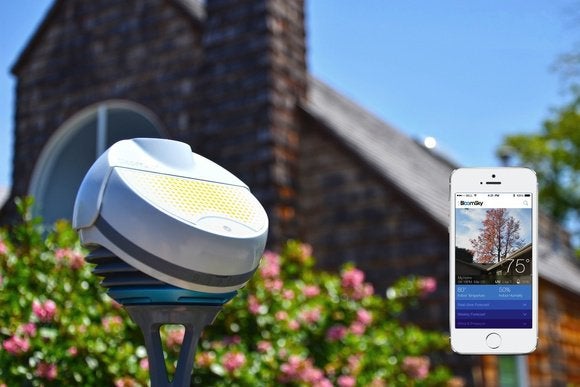
As outdoor enthusiasts, the weather often plays a major role in determining when we can and can't go outside to enjoy the activities the we love so much. If you're like me, you probably spend an inordinate amount of time checking the forecast and current conditions to help to determine when is the best possible time to be outside, and just how you should dress for the occasion. At times, you might have even wished that you could own your own personal weather station that could provide updates and information on the conditions that exist right outside your door. Well, if that has ever been something you've dreamed of, than you're definitely going to want to take a look at BloomSky, a device designed to provide accurate weather information and a whole lot more.
Packed with a host of high-tech sensors, BloomSky is a device that you set up outside your home, office, or other location to record and share weather data. It can detect temperature, humidity, barometric pressure, the current level of UV radiation, and precipitation. That information is than shared directly with you via a smartphone app, which can also be configured to provide alerts based on changing conditions.
As if that wasn't enough, the BloomSky weather station also features a built-in camera, which can be accessed via the app as well. The camera can provide a wide-angle image of the sky or the area that surrounds the device at any given time during the day. Those images are even saved up as the hours pass, providing a nice time-lapse video of how things unfolded from dusk until dawn.
Setting up the BloomSky is a breeze, and takes just a matter of moments. Do to so, you must first download the app to your iPhone or Android phone, and create an account. Once you've done that, you'll be able to manage your devices, giving it its own unique name and configuring a few basic settings. The most important of those settings is granting it access to your WiFi network, which is how the weather station shares its data. That means that when you pick a spot outside, it also has to be within range of a wireless network, otherwise you won't be able to connect to it.
Fortunately, the BloomSky comes equipped with a high quality WiFi chip that seems to have solid range. I configured mine to my wireless router, than took it outside to set up in the yard. It immediately started broadcasting weather data and even some images of my ugly mug up close to the camera as I installed it. The entire process took less than five minutes, and before I knew it my personal weather station and camera system was in place, and broadcasting to the world.
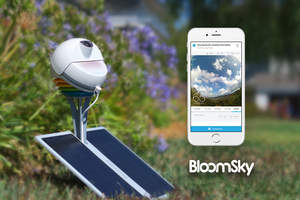
The BloomSky device also features a built-in rechargeable battery that keeps it powered for up to two weeks at a time. But, there is also an optional solar panel that can be connected to the unit to provide a constant source of power. That's the method I've been using to keep my weather station operational, and it seems to be working like a charm. The BloomSky app provides an on-screen indicator of current battery life, and mine hasn't wavered a bit since installing it.
In addition to providing current weather conditions for yourself, there is also a bit of a social element to BloomSky. When you set up the device, you can opt to have its data shared publicly, or make it private so only you see it. Most users are sharing their data, and as a result there is a growing network of BloomSky weather stations across the globe. This gives you the option to search for different locations within the app, allowing you to check the weather in many parts of the world, complete with an image from the camera onboard those other BloomSky devices. To get a sense of where these weather stations are located, take a look at this real-time map that is constantly being updated with new locations. You can also get a sense of where the devices are installed by following the BloomSky Instagram account, which includes some great shots of cameras too.
The BloomSky app is a pretty easy to use, straight forward affair. When launched, it takes you straight to your own device, but also lists other that are nearby as well. Tapping on your personal weather station � or one of the other son the list � gives you more information, including an hourly forecast for the day, and the outlook for the rest of the week, for the place that the device is located. It also allows you to share data via social networking, and gives you the option to save other BloomSky devices to your favorites.
As much fun as having your very own weather station is, the BloomSky isn't without its faults. For instance, the data it provides to you comes in raw numbers, which out of context isn't always helpful. Sure, the temperature and humidity numbers are pretty self explanatory, but barometric pressure is more useful if you know whether or not it is rising, falling, or is stable. I would like to see that option added in the future. The UV radiation indicator was originally a number as well, which meant absolutely nothing to the layman. But now, it has been replaced with a much more useful low, medium, or high rating. Additionally, the app was a bit unstable when I first started using it, but a recent update to fix some bugs seems to have ironed out those issues.
I'd also like to see some kind of history added to the app as well. As it stands, the data is transitory, disappearing as the day goes by. But being able to keep the data and analyze it over time could prove helpful. BloomSky could even grow to the point that it is providing long-term analysis of weather and climate change from across its global network. At this point, that doesn't seem likely though. I also wish that the device had some kind of wind speed indicator and a rain gauge to know just how much precipitation you've had over a certain period of time.
The app also seems to only be available for smartphones at the moment. I'd really like to have it be an option on my iPad as well however. Better yet, I'd like to see a BloomSky app for the new Apple TV as well, allowing me to check conditions and watch the time-lapse videos on my big screen. I'm not sure how likely that is to happen, but it sure would be nice.
That said, there are some nice features about the BloomSky that I really like. I appreciate that it sends me a notification when it starts to rain for instance. I also love the time-lapse videos that it creates each day, and the ability to save them for future viewing should something truly interesting get caught on camera. On top of that, there i something quite satisfying about having your own weather station out in the backyard, providing you realtime data about what is happening around you.
If you have a weather-obsessed person on your holiday shopping list, this would be quite the gift to find under the tree this year. The BloomSky is sold in several different packages, including the basic model which features the weather station by itself. That unit typically sells for $199, but is currently on sale for $149. Additionally, the package that includes the solar panel to power the device typically goes for $337, but is now just $186. That's a heck of deal, and is the one that I would personally recommend, as once it is configured and installed, you can pretty much forget about it. You can see all of the holiday specials, as well as options for mounting the device on a deck, as well as buying the solar panel separately, on the BloomSky online shop.
The bottom line is that this is a unique and fun piece of technology that has a lot of potential. I already enjoy watching the weather from my device, and searching for other stations in different locations around the world. As the product and the app continue to be refined, I think we'll see even more functionality show up from BloomSky, but even now it is a nice option to have at your disposal.
Final 2015 Adventure Racing World Series Rankings Revealed
With the Adventure Racing World Championships being held in Brazil last month, another season of the AR World Series has come to a close. Earlier in the week, the final rankings for 2015 were released, and for those of us who follow the sport closely there are some familiar names at the top.
The rankings are a result of how teams finish over the course of the entire season, which began last February at the GODZone Race in New Zealand and wrapped up at Pantanal Pro in Brazil. Each team receives a point value based on their performance, although sometimes their overall score is skewed by how often they race. Still, the best teams do tend to gravitate to the top of the list, and the best team in the world is definitely ranked number one in my opinion. So, without further ado, here how the top adventure racing teams stacked up, along with their point totals for the season:
1 - Seagate - 700The 2016 season will begin in February at the Maya Mountain Adventure Challenge in Belize, and the ARWS will have another full schedule of events planned for the months that will follow. It should be another interesting year, with some great races set to take place on five continents, including the World Championships being held in Australia.
2 - Columbia Oncosec - 556
3 - Adventure Medical Kits - 458
4 - Hagl�fs Silva - 398
5 - Swedish Armed Forces Adventure Team - 371
6 - Raidlight-Naturex - 364
7 - Merrell - 355
8 - GODZone Adventure Team - Expedicion Guarani - 338
9 - Peak Performance 306
10 - YogaSlackers - 275
11 - Estonian ACE Adventure - 223
11 - France Green Caffte Costa Rica - 223
13 - R'ADYS Team Switzerland - 218
14 - Ecuador Movistar - 183
15 - Arverne Outdoor - 176
16 - Bivouac Inov-8 - 160
17 - Sweco Adventure - 150
18 - Fenix Multisport - Adidas - 133
19 - DART Nuun - 108
20 - Chimpanzee Bar - 105
20 - Kailash Brou Aventuras - 105
30 Fantastic Things To Do In Winter
We're now less than a week away from the official start of winter, and for many people that means shutting down their outdoor adventures until the arrival of spring. But for those of us who don't see a little cold weather and snow as a barrier to being outside, it is just another time of year to pursue our passions. To help us in that area, Outside magazine has compiled a list of the 30 best things to do in winter, giving us a bucket list for the season ahead.
Most of Outside's suggestions are approachable, even if they seem like something that would be tough to accomplish. For instance, they start the list by recommending we all go skiing with Chris Davenport, one of the most accomplished ski-mountaineers ever. At first glance, you're apt to ask yourself how that would ever be possible, but it turns out Davenport is going to be guiding on Aspen Mountain in March, and if you have enough cash you can join him.
Other suggestions are a bit more reasonable. For instance, they offer suggestions on where you can drive a snowcat or go fat tire biking. There are also options for soaking in a hot spring, going heli-skiing on a budget, and climbing and skiing a volcano. In short, there are so many possibilities on the list that you'll likely need ten winters to accomplish them all.
I like this list because it eliminates the excuses that many people make for not enjoying the winter season. Sure, its cold and windy, but that's also part of the fun. With the right gear however, you can spend all day outdoors and still be very comfortable. Besides, as an avid lover of the outdoors, why would you ever want to spend an entire season avoiding the elements, when you could be embracing them for an even more fulfilling experience. Winter is nearly here. Enjoy it to the fullest!
Selasa, 15 Desember 2015
Video: The Trail to Kazbegi - Mountain Biking Through the Caucasus Mountains
Looking for a healthy dose of adventure today? Check out this video that follows a team of four mountain bikers on a 10-day journey through the Caucasus Mountains in the country of Georgia. Along the way they discover a host of challenges that include raging rivers, snowcapped peaks, trails that feature tough climbs and blistering descents, and so much more. This is an expedition to a part of the world that doesn't see many outsiders, let alone ones riding along on mountain bikes. The short film gives us a taste of that experience, along with some amazing views of the landscapes they discovered along the way.
The Trail To Kazbegi from Joey Schusler on Vimeo.
Langganan:
Postingan (Atom)